

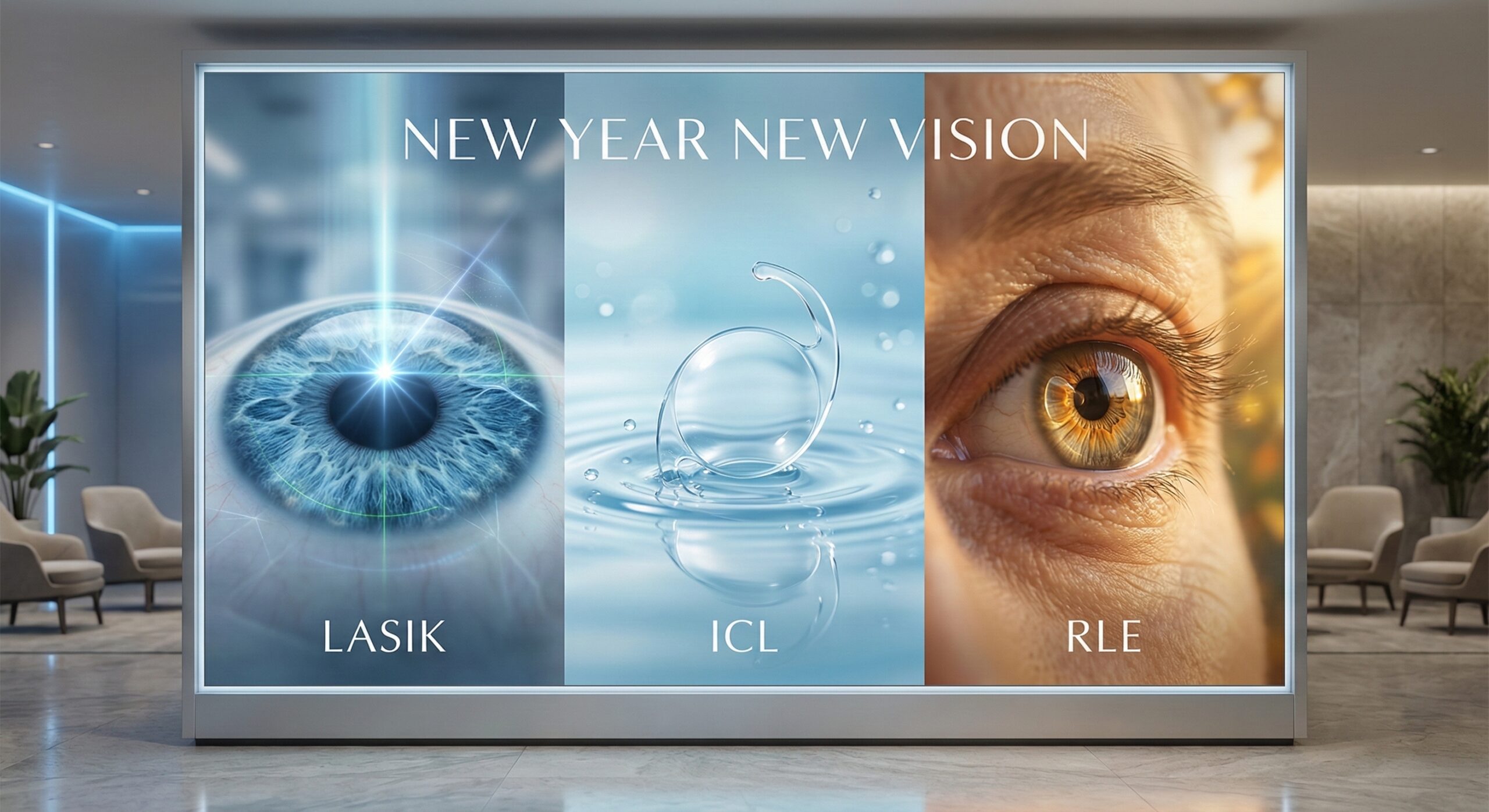
New Year, New Vision in DFW: LASIK vs EVO ICL vs RLE — Which Is Right for You?
If one of your goals this year is to simplify life, seeing clearly without contacts or glasses is a practical upgrade you’ll notice every day—driving at night, working on screens, traveling, and keeping up with a busy schedule. The good news is that modern vision correction is not one-size-fits-all. At Azure Eye Center, we commonly help patients across Alliance, Fort Worth, Colleyville, Keller, and Haslet, Texas compare three leading options: LASIK, EVO ICL, and Refractive Lens Exchange (RLE).
Below is a straightforward breakdown of what each option does best, who it’s best for, and what recovery often looks like—so you can make a confident decision for your vision goals in DFW.
Quick comparison: LASIK vs EVO ICL vs RLE
- LASIK: Laser vision correction for many common prescriptions; fast recovery for many patients.
- EVO ICL: Implantable lens option often ideal for higher prescriptions or patients who aren’t candidates for corneal laser surgery.
- RLE: Lens-based vision correction that can reduce dependence on glasses/contacts and may address age-related focusing changes.
If you already know which options you’re leaning toward, you can explore each procedure here: LASIK, EVO ICL, and Refractive Lens Exchange (RLE) in DFW.
Option 1: LASIK in Fort Worth, Colleyville, Keller, Alliance, and Haslet
What it is: LASIK reshapes the cornea to correct nearsightedness, farsightedness, and astigmatism in many patients. It is known for quick visual recovery and strong outcomes when you’re a good candidate.
Best candidates often include people who:
- Have a stable prescription
- Have healthy corneas with appropriate thickness and shape
- Want a faster return to normal routines in DFW (work, school pickup, travel, sports)
Typical recovery experience (general):
- Many patients notice significant improvement quickly, with ongoing refinement as the eyes heal
- Temporary dryness or light sensitivity can occur early on
- Your surgeon will advise on activity restrictions and drops based on your specific measurements
Why many DFW patients choose LASIK:
- Speed and convenience
- Proven track record
- Often the most familiar laser vision correction option
Important considerations: LASIK is not ideal for everyone. Corneal thickness, corneal shape, tear film quality (dry eye), and prescription range all matter. That is why a consultation is essential—especially if you’ve been told previously that you “might not qualify.”
Option 2: EVO ICL in DFW (often ideal for higher prescriptions)
What it is: EVO ICL is an implantable lens placed inside the eye (behind the iris and in front of your natural lens). Instead of reshaping the cornea, it corrects vision with an internal lens—often described as a permanent, invisible contact lens.
Best candidates often include people who:
- Have moderate to higher levels of nearsightedness (and in many cases, astigmatism)
- Are not ideal candidates for LASIK due to corneal thickness or other corneal factors
- Want a vision correction option that does not remove corneal tissue
Typical recovery experience (general):
- Many patients experience rapid functional improvement
- Close follow-up ensures the lens is positioned properly and the eye is healing well
- Your surgeon will review risks and benefits based on your measurements and ocular health
Why patients in Fort Worth, Colleyville, Keller, Alliance, and Haslet consider EVO ICL:
- Excellent option for higher prescriptions
- No corneal reshaping
- In many cases, the lens can be removed or exchanged if clinically necessary
Option 3: Refractive Lens Exchange (RLE) in DFW
What it is: Refractive Lens Exchange (RLE) is a lens-based procedure that replaces the eye’s natural lens with an intraocular lens (IOL). RLE can be especially attractive for patients who want to reduce dependency on glasses and are also starting to notice age-related changes in near vision (for example, needing readers).
Best candidates often include people who:
- Are typically in the age range where reading vision changes become more noticeable
- Want a long-term, lens-based solution rather than corneal laser correction
- Are not ideal candidates for LASIK due to prescription range or corneal factors
- Want to address both distance and near vision goals (depending on lens selection and your candidacy)
Typical recovery experience (general):
- Vision may improve quickly, with stabilization over time as the eye heals
- Follow-up visits are essential to monitor healing and fine-tune expectations
- Your doctor will explain lens options, what you can realistically expect for near and distance vision, and whether you may still need glasses for certain tasks
Why RLE is popular with many DFW patients:
- It can reduce dependence on glasses/contacts
- It addresses age-related lens changes rather than only reshaping the cornea
- It offers a path for patients who may not be ideal LASIK candidates
How to choose the best procedure in Alliance, Fort Worth, Colleyville, Keller, or Haslet
Most patients should not try to “self-diagnose” the right procedure from online lists. The right plan comes down to objective testing and your lifestyle priorities, including:
- Corneal thickness and shape
- Prescription and stability
- Dry eye status and tear film quality
- Night driving and glare sensitivity
- Age and near-vision needs
- Overall ocular health and long-term goals
A proper consultation in DFW should end with a clear recommendation: LASIK, EVO ICL, RLE, or occasionally a different plan if your eyes require it.
Common questions we hear from DFW patients in January
“Is January a good time to do this?”
Yes—January is a common time to act because people are motivated by fresh goals and it can be easier to plan around work and family routines. If you’re in Fort Worth, Colleyville, Keller, Haslet, or Alliance, scheduling a consult early in the year also gives you more flexibility for timing.
“What about astigmatism?”
LASIK, EVO ICL, and RLE can address astigmatism in many cases. The best option depends on your measurements and overall ocular health.
“Will I still need reading glasses?”
This depends heavily on age, your current near vision, and the option you choose. RLE is often part of this conversation because it can be designed around both distance and near goals depending on lens selection and candidacy. Your consultation should include a realistic discussion of what “glasses-free” looks like for your day-to-day life.
Why the surgeon matters: meet Dr. Truong
Technology is important, but outcomes are driven by good decision-making, precise measurements, and surgical expertise. At Azure Eye Center, your care is led by Dr. Truong, who is Fellowship Trained in Cornea and Refractive Surgery. If you’re researching vision correction in DFW, you can learn more about your surgeon here: Meet Dr. Truong.
Next step: schedule a vision correction consultation in DFW
If you live in Alliance, Fort Worth, Colleyville, Keller, or Haslet, Texas, the fastest way to get a confident answer is a consultation with advanced testing and a personalized recommendation.
Explore the procedures and then take the next step: LASIK, EVO ICL, and Refractive Lens Exchange in DFW—or start by learning more about Dr. Truong and the approach at Azure Eye Center.