

Fuchs’ Dystrophy
Fuchs’ Dystrophy: Understanding and Managing Corneal Dystrophy
If your vision is hazy in the morning, you notice increasing glare and halos, or it feels like your prescription keeps changing, the issue may not be your glasses—it may be your cornea. Fuchs’ Endothelial Corneal Dystrophy (Fuchs’ dystrophy) is a progressive condition that affects the endothelial cell layer on the back surface of the cornea. As these cells weaken over time, the cornea can retain excess fluid, causing swelling and clouding that leads to fluctuating or progressively blurry vision.
At Azure Eye Center, we provide comprehensive cornea evaluation and treatment planning for patients throughout Fort Worth, Colleyville, Alliance/FTW, Keller, Saginaw, North Richland Hills, and Haslet, Texas. Your care is guided by Dr. David T. Truong, an ophthalmologist with cornea and refractive expertise.
You can learn more about him here:
Meet Dr. Truong
What is Fuchs Dystrophy
What Is Fuchs’ Dystrophy?
The cornea is the clear front window of your eye. It must stay smooth and properly dehydrated to remain transparent. The endothelium is the innermost layer of the cornea—its cells act like microscopic pumps that remove extra fluid to keep the cornea clear.
In Fuchs’ dystrophy, endothelial cells gradually lose function. As they decline, fluid builds up within the cornea, causing corneal edema (swelling). This swelling can blur vision, increase glare, and create a “foggy” or “steamy glass” effect, especially early in the morning.
If you’re not sure how the cornea’s layers work or why endothelial health matters, this page provides a clear overview:
Understanding the Cornea and Conditions
Why Vision Is Often Worse in the Morning
A classic symptom of Fuchs’ dystrophy is blurrier vision upon waking that improves later in the day. Overnight, your eyes are closed, which reduces evaporation from the ocular surface. For a cornea with compromised endothelial function, that can mean additional fluid accumulation. When you wake up and your eyes open, evaporation increases and the cornea may gradually dehydrate—improving clarity as the day progresses.
As Fuchs’ advances, swelling can become more persistent, and the “morning blur” may last longer—or become an all-day issue.
Causes and Risk Factors
- Genetic predisposition: Often inherited.
- Age: Typically manifests after age 50.
- Gender: More common in women.
Symptoms
Fuchs’ dystrophy often starts subtly. Symptoms may include:
Blurry or cloudy vision, often worse in the morning
Glare and halos, especially around lights at night
Reduced contrast (colors and details look dull or washed out)
Light sensitivity
Difficulty driving at night
Fluctuating vision that comes and goes
In advanced cases, eye irritation or pain if swelling causes surface changes
Because these symptoms can overlap with dry eye and cataracts, it’s important to evaluate the cornea directly with corneal-specific testing—not just a basic eye exam.
Who is at Risk?
Fuchs’ dystrophy can occur for multiple reasons, but common factors include:
Family history (it may run in families)
Age-related progression (symptoms often become noticeable later in adulthood)
Higher prevalence in women in many clinical descriptions
Coexisting conditions such as cataracts (which often appear in the same age range)
If you live in Fort Worth, Colleyville, Keller, Haslet, Saginaw, North Richland Hills, or Alliance/FTW and you’ve been told you have “corneal guttae,” “endothelial weakness,” or “early Fuchs,” it’s worth getting a detailed cornea evaluation to determine the stage and a plan.
How We Diagnose Fuchs' Dystrophy
A meaningful diagnosis isn’t just “yes or no.” The goal is to determine:
How advanced the condition is, and
How likely it is to affect your vision and surgical options, especially if you also have cataracts.
Your evaluation may include:
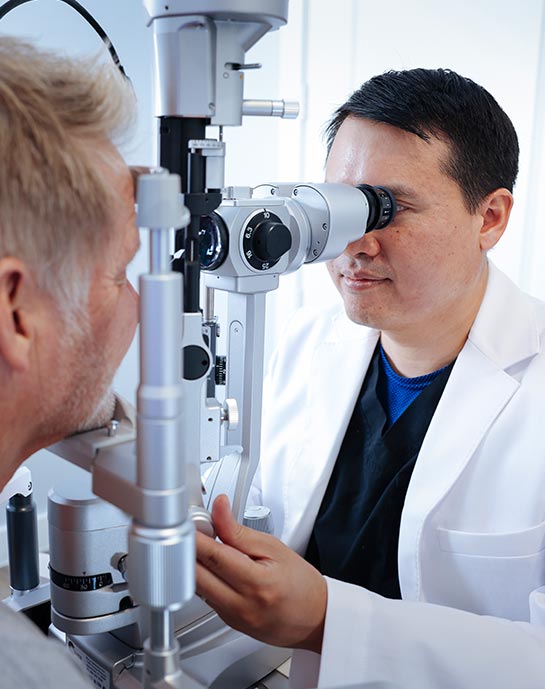
Slit-Lamp Examination
A microscope exam that allows us to look for hallmark changes such as guttae and corneal haze/edema.
Corneal Pachymetry (Thickness Mapping)
Measures corneal thickness. As swelling increases, the cornea can become thicker, which helps us understand severity and progression.
Specular Microscopy (Endothelial Cell Analysis)
Evaluates the endothelial cell layer’s density and structure. This is one of the most valuable tests for confirming endothelial compromise and monitoring disease progression over time.
Corneal Imaging (When Needed)
Additional imaging may help quantify swelling patterns and corneal clarity—particularly if cataract surgery planning is part of the discussion.
For a broader overview of corneal anatomy and related conditions, see:
<a href=”https://azureeyecenter.com/understanding-the-cornea-and-conditions/”>Understanding the Cornea and Conditions</a>
Treatment Options
1) Non-Surgical Treatment (Early to Moderate Fuchs’)
In early stages, the goal is to reduce swelling and improve daily vision consistency. Treatment may include:
Hypertonic saline drops or ointment to help draw fluid out of the cornea
Lubrication for ocular surface comfort
Lifestyle and environmental adjustments (as appropriate) to reduce symptom burden
Non-surgical treatment does not reverse Fuchs’ dystrophy, but it can improve quality of life and delay the need for surgery in many patients.
2) Advanced Treatment: Endothelial Keratoplasty (Partial-Thickness Corneal Transplant)
When the cornea can no longer stay clear due to endothelial failure, the most effective long-term solution is typically endothelial keratoplasty, a modern approach that replaces the damaged inner corneal layers while leaving the rest of the cornea intact.
Common techniques include:
DMEK (very thin endothelial replacement)
DSEK/DSAEK (slightly thicker endothelial replacement)
Your candidacy depends on corneal clarity, thickness, symptom severity, and your overall eye health.
3) Full-Thickness Corneal Transplant (Selective Cases)
In certain complex cases—especially when there is significant corneal scarring or additional corneal pathology—a full-thickness transplant may be considered. However, many Fuchs’ patients can be treated with endothelial-focused procedures.

Fuchs’ Dystrophy and Cataracts: Strategic Timing Matters
Why Patients Choose Dr. Truong
Patients come to Azure Eye Center from Fort Worth, Colleyville, Alliance/FTW, Keller, Saginaw, North Richland Hills, and Haslet because they want cornea care guided by a fellowship-trained corneal specialist. Dr. David T. Truong brings advanced corneal training and a detail-driven approach to diagnosing and treating conditions like Fuchs’ dystrophy, where timing, testing, and surgical strategy matter.
At Azure Eye Center, patients value:
Specialized corneal evaluation and diagnostic testing to confirm the stage and severity of Fuchs’ dystrophy
A stage-based treatment plan tailored to symptoms, lifestyle, and long-term visual goals
Expert guidance when Fuchs’ dystrophy and cataracts overlap, including careful surgical planning and expectations
Modern, evidence-based treatment pathways with thoughtful timing to protect corneal health and optimize outcomes
To learn more about Dr. Truong and the clinical approach behind your care, visit:
<a href=”https://azureeyecenter.com/meet-dr-truong/”>Meet Dr. Truong</a>
Schedule an Appointment
If you have been diagnosed with Fuchs’ dystrophy—or you’re experiencing morning blur, glare, halos, or worsening corneal haze—schedule a corneal evaluation at Azure Eye Center. We serve patients across Fort Worth, Colleyville, Alliance/FTW, Keller, Saginaw, North Richland Hills, and Haslet, TX with personalized treatment planning and modern corneal care.
Request A
Consultation
To request a consultation with Azure Eye Center, please click link below.