

Home / Cataracts / IOL Options / TECNIS Symfony
Cataract surgery · Extended depth of focus (EDOF)
TECNIS Symfony® IOL in Fort Worth & Colleyville, TX
The TECNIS Symfony is an extended depth of focus lens that gives you a continuous range of vision from distance through intermediate after cataract surgery. Dr. David Truong offers it to patients in Fort Worth, Colleyville, Keller, and across the DFW area.


The short answer
What is the TECNIS Symfony IOL?
The TECNIS Symfony is an extended depth of focus (EDOF) intraocular lens used in cataract surgery. Instead of focusing light at one point, it stretches focus into a continuous range, so most patients see clearly at distance and intermediate range, such as a car dashboard or computer screen, with useful near vision for many tasks.
Made by Johnson & Johnson Vision, Symfony was the first EDOF lens approved in the United States. It is a premium option for Fort Worth and Colleyville patients who want to rely less on glasses than a standard monofocal lens allows.
How it works
How does the TECNIS Symfony work?
A standard monofocal lens focuses light at a single distance. The Symfony uses a special diffractive pattern, called an echelette design, to lengthen the zone of focus into one continuous range instead of separate focal points.
It also corrects chromatic aberration, the slight blur caused when different colors of light focus at different points. That helps contrast and sharpness, including in lower light.
- ✓Continuous range. Vision flows from distance to intermediate without a gap in the middle.
- ✓Sharper contrast. Color correction helps images look crisp.
- ✓Fewer trade-offs. Designed to cause fewer halos than traditional multifocal lenses.

Candidates
Who is a good candidate for the Symfony lens?
The Symfony is a good fit for many cataract patients who want more range than a monofocal lens. It may suit you if you:
- ✓Need cataract surgery and want to reduce your dependence on glasses
- ✓Spend much of your day on a computer, tablet, or phone
- ✓Drive often and want clear distance vision and a readable dashboard
- ✓Are comfortable using light readers for small print
- ✓Have astigmatism and want it corrected with the Symfony Toric
Patients who want the sharpest possible night vision with no halos at all, or who have certain retinal or optic nerve conditions, may do better with a different lens. Dr. Truong will help you weigh the options at your exam in Fort Worth or Colleyville.

Benefits
Benefits of the TECNIS Symfony IOL
Symfony is built for the distances most people use every day.
Continuous vision
A smooth range from distance through intermediate, with fewer gaps than a multifocal.
Less need for glasses
Many patients go without glasses for driving, computer work, and everyday tasks.
Clear contrast
Chromatic aberration correction helps keep images crisp, including in dim light.
Screen-friendly
Comfortable intermediate vision for phones, tablets, and computers.
Astigmatism option
The Symfony Toric corrects astigmatism in the same procedure.
Proven platform
Built on the TECNIS lens platform used in cataract surgery worldwide.
Compare
TECNIS Symfony vs. other lens options
The right lens depends on your eyes and how you use your vision.
| Lens option | Vision range | Reading glasses | Night glare | Astigmatism |
|---|---|---|---|---|
| Monofocal | Distance only | Usually needed for near | Minimal | Toric available |
| TECNIS Symfony (EDOF) | Distance and intermediate | Sometimes for small print | Some halos possible | Symfony Toric |
| TECNIS PureSee (EDOF) | Distance and intermediate, some near | Light readers for fine print | Very low | Toric II available |
| Alcon Vivity (EDOF) | Distance through intermediate | Sometimes for fine print | Low | Toric available |
| Trifocal (PanOptix Pro) | Near, intermediate, and distance | Rarely | Some halos possible | Toric available |
See every lens Dr. Truong offers on our cataract IOL options page.
Surgery and recovery
What to expect with Symfony cataract surgery
Symfony is placed during routine outpatient cataract surgery, one eye at a time. Your eye is numbed with drops, the cloudy lens is removed, and the Symfony lens is placed in its place permanently. Laser assistance with LensAR is available.
Recovery
Most patients notice clearer vision within a few days. Your brain adapts to the new range of focus over several weeks, and some patients notice mild halos around lights at night that often become less noticeable over time. Follow-up visits and eye drops are part of every plan.

Your surgeon
Why choose Dr. Truong for your Symfony lens?
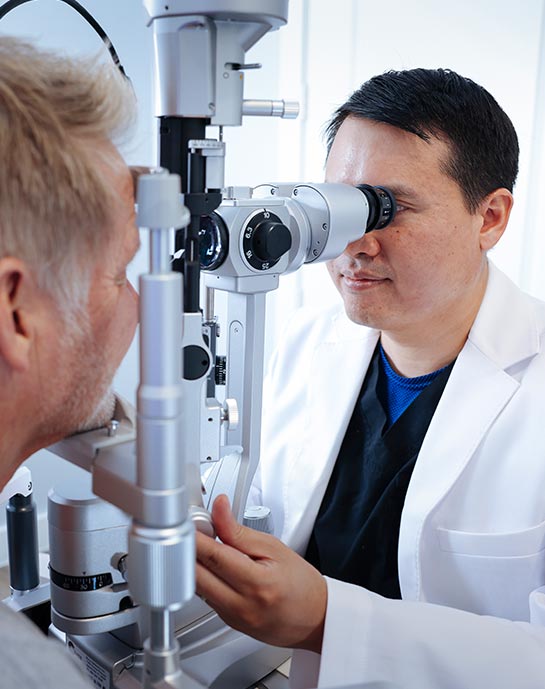
Dr. David Truong is a board-certified ophthalmologist who completed fellowship training in cornea and refractive surgery at UCLA’s Jules Stein Eye Institute. He evaluates your eye health, measurements, and daily routine before recommending a lens, rather than steering every patient to the same option.
- ✓Full range of lenses, including EDOF, trifocal, toric, and the Light Adjustable Lens.
- ✓Precise planning with advanced measurements and optional LensAR laser assistance.
- ✓Accredited surgery suite with Joint Commission accreditation for office-based surgery.
- ✓Two offices in Fort Worth (Alliance) and Colleyville.
Cost & coverage
Is the TECNIS Symfony covered by insurance?
Medicare and most insurance plans cover medically necessary cataract surgery with a standard lens. The Symfony is a premium lens, so it involves an out-of-pocket upgrade cost. Our team reviews your coverage and costs before surgery, and financing is available.
See financing optionsFor details, see cataract surgery cost and Medicare coverage in Fort Worth.
Two locations
TECNIS Symfony lens near you in Fort Worth and Colleyville
Consultations and follow-up visits are available at both offices, with Dr. Truong and optometrist Dr. Samantha Reynolds. Both offices are open Monday–Thursday 8:00 am–5:00 pm and Friday 8:00 am–3:00 pm.
(817) 886-4600
(817) 886-4600
Coming from Keller or Southlake? See eye surgery for Keller and Southlake patients.
FAQ
TECNIS Symfony IOL FAQs
What is an extended depth of focus lens?
An extended depth of focus (EDOF) lens stretches focus into one continuous range instead of a single point. This gives clear distance and intermediate vision with useful near vision, with fewer visual side effects than many multifocal lenses.
Will I need glasses after the Symfony lens?
Many patients rarely need glasses for distance and intermediate tasks, but readers can help for small print or long periods of reading. Results vary with your eyes and the setup Dr. Truong recommends.
Does the Symfony cause halos or glare?
Some patients notice mild halos around lights at night, especially early in recovery. They are typically less pronounced than with traditional multifocal lenses and often become less noticeable as your brain adapts.
Can the Symfony correct astigmatism?
Yes, with the TECNIS Symfony Toric. The toric version corrects astigmatism at the same time as your cataract surgery, so your range of vision stays sharp.
How is Symfony different from the TECNIS PureSee?
Both are EDOF lenses from Johnson & Johnson Vision. Symfony uses a diffractive echelette design, while PureSee uses a purely refractive design built to keep halos very low. Dr. Truong can explain which fits your eyes and night-driving needs.
Does insurance cover the TECNIS Symfony?
Insurance covers the cataract surgery, but the Symfony is a premium lens upgrade with an added cost. Our team reviews your coverage and financing options before surgery.
Where can I get the TECNIS Symfony near Fort Worth?
Azure Eye Center offers the Symfony at our Fort Worth (Alliance) and Colleyville offices, serving patients from Keller, Southlake, Grapevine, and North Richland Hills. Call (817) 886-4600 to schedule.
Related pages
Find out if the TECNIS Symfony is right for you
Schedule a cataract consultation in Fort Worth or Colleyville. Dr. Truong will review your eye health and vision goals and help you choose the right lens.
This page is for general education and is not medical advice. Candidacy, treatment options, risks, and results vary by patient and are determined at an in-person exam with your eye doctor.