

Home / Vision Correction
LASIK & Vision Correction · Fort Worth & Colleyville
Vision Correction in Fort Worth: LASIK, PRK, EVO ICL & Lens Replacement
Vision correction surgery, also called refractive surgery, reduces your need for glasses or contact lenses by changing how your eye focuses light. At Azure Eye Center in Fort Worth and Colleyville, Dr. Truong performs LASIK, Contoura Vision, PRK, EVO ICL and refractive lens exchange. Because he offers every option, your recommendation is based on your eyes, not on the one procedure a clinic happens to sell.

Quick answer
What is refractive surgery?
Refractive surgery is any eye procedure that corrects nearsightedness, farsightedness, astigmatism or presbyopia so you depend less on glasses or contacts. It works in one of two ways: a laser reshapes the cornea (LASIK, Contoura, PRK), or a lens is placed inside the eye (EVO ICL, refractive lens exchange). Your eye exam determines which approach fits.
Laser procedures need a healthy cornea of adequate thickness. Lens-based procedures help when the cornea is thin, the prescription is high, or the natural lens has started to stiffen after about age 45.
Decision guide
Which vision correction procedure fits your age?
Age is a useful first filter because the eye changes over time. The ranges below are typical, not rules. Your measurements decide.
20s to 30s and up: LASIK or PRK
If your prescription is stable and your corneas are healthy and thick enough, laser vision correction is usually the first option Dr. Truong evaluates. PRK is the alternative when a corneal flap is not a good idea.
Ages 21 to 45: EVO ICL
For higher nearsightedness, thin corneas, or other reasons LASIK is not a fit, an implantable lens can correct your vision without removing corneal tissue.
About 45 to 65: Lens replacement
Once presbyopia sets in, or for higher farsightedness, refractive lens exchange replaces the natural lens with an implant chosen for your distance and near vision goals.
Any age with a cataract: Cataract surgery
When the natural lens is cloudy, cataract surgery is the right procedure. Premium lens options can also reduce how much you rely on glasses afterward.
Procedures
What vision correction procedures does Azure Eye Center offer?
Azure offers three laser treatments on the cornea and four lens-based procedures. Each card explains who it usually suits.
LASIK
LASIK creates a thin flap in the cornea, then a laser reshapes the tissue beneath it to correct nearsightedness, farsightedness or astigmatism. Dr. Truong uses the Alcon WaveLight PLUS refractive suite.
LASIK eye surgery in Fort Worth →Contoura Vision
Contoura Vision is topography-guided LASIK. It maps about 22,000 elevation points on your cornea so treatment is based on your eye's individual shape. It is FDA-approved for nearsightedness with or without astigmatism.
Contoura Vision LASIK →PRK
PRK reshapes the surface of the cornea without a flap, and the outer layer grows back on its own. Recovery is longer, from several days to a few weeks. PRK is often a better fit for thin corneas, dry eye, large pupils, or contact sports and high-impact jobs.
PRK laser eye surgery in Fort Worth →EVO ICL
The EVO Implantable Collamer Lens sits inside the eye, in front of your natural lens, to correct nearsightedness with or without astigmatism. No corneal tissue is removed, and the lens can be removed if needed. The procedure takes about 20 to 30 minutes.
EVO ICL in Fort Worth →Refractive Lens Exchange
RLE is the same procedure as cataract surgery, done to correct vision rather than remove a cloudy lens. It is usually considered from about age 45 for presbyopia or high farsightedness.
Refractive lens exchange →Light Adjustable Lens
The Light Adjustable Lens is an implant whose power can be fine-tuned after surgery with short light treatments once your eye has healed. That lets you and Dr. Truong adjust your vision before the result is locked in.
Light Adjustable Lens →Cataract Surgery
If a cataract is clouding your vision, cataract surgery replaces the cloudy lens with a clear implant. Dr. Truong offers LensAR laser-assisted surgery and premium lenses that can reduce your dependence on glasses.
Cataract surgery in Fort Worth →Compare
LASIK vs PRK vs EVO ICL vs lens replacement: how do they compare?
The main difference is where the correction happens: on the cornea (LASIK, Contoura, PRK) or with a lens inside the eye (EVO ICL, refractive lens exchange, cataract surgery).
| Procedure | How it works | Typical candidate | Recovery | Reversible? | Where performed |
|---|---|---|---|---|---|
| LASIK | Laser creates a corneal flap, then reshapes the cornea | 20s to 30s and up; stable prescription; adequate corneal thickness | Many patients see clearly within a day or two | No; the corneal change is permanent | Laser procedure with the Alcon WaveLight PLUS suite |
| Contoura Vision | Topography-guided LASIK based on about 22,000 corneal points | Nearsightedness with or without astigmatism | Similar to LASIK | No | Laser procedure |
| PRK | Laser reshapes the corneal surface; no flap | Thin corneas, dry eye, large pupils, contact sports or high-impact jobs | Several days to a few weeks | No | Laser procedure |
| EVO ICL | Implantable lens placed in front of the natural lens | Ages 21 to 45; higher nearsightedness or thin corneas | Short procedure; most patients notice clearer vision quickly | Yes; the lens can be removed | Joint Commission-accredited office-based surgery suite |
| Refractive lens exchange | Natural lens replaced with an implant | About 45 to 65; presbyopia or high farsightedness | Similar to cataract surgery | Not designed to be reversed | Joint Commission-accredited office-based surgery suite |
| Light Adjustable Lens | Implant power fine-tuned with light treatments after healing | Lens surgery patients who want to adjust their result | Several weeks of adjustment visits | Adjustable until locked in, then permanent | Implanted during lens surgery in the office suite |
| Cataract surgery | Cloudy lens replaced with a clear implant | Anyone whose cataract affects daily vision | Similar to refractive lens exchange | Not designed to be reversed | Joint Commission-accredited office-based surgery suite |
Recovery varies by patient. Dr. Truong reviews the expected recovery for your specific procedure at your consultation. Learn more about our office-based surgery suite.
Your consultation
How do I know which one is right for me?
A consultation with measurements answers this. Dr. Truong's team measures your cornea, prescription and lens health, then explains which procedures you qualify for and why.
- ✓Corneal mapping. Topography shows the shape of your cornea and screens for irregularities, such as keratoconus, that rule out some laser options.
- ✓Corneal thickness. Thickness helps decide between LASIK, PRK and a lens-based option like EVO ICL.
- ✓Prescription and stability. How nearsighted, farsighted or astigmatic you are, and whether your prescription has changed recently.
- ✓Age and focusing ability. After about 45, near vision changes, which can shift the recommendation toward lens replacement.
- ✓Lens health. Early cataract changes point toward lens-based treatment rather than a laser procedure.
The free LASIK consultation also screens you for PRK, ICL and RLE, so one visit can show you every option you qualify for. If you are coming in specifically for EVO ICL, lens replacement or cataract evaluation, our team will schedule the consultation that fits.
Before you book, you can take the LASIK self-test or read our LASIK vs RLE vs EVO ICL comparison for Fort Worth patients.
Cost & financing
How much does vision correction cost in Fort Worth?
Cost depends on the procedure, the technology used and your prescription. Azure Eye Center gives you your exact price in writing at your consultation.
Laser procedures are generally priced per eye. EVO ICL and refractive lens exchange typically cost more because they involve an implant placed inside the eye. Insurance usually does not cover elective vision correction, but HSA and FSA funds can often be used.
Our LASIK cost guide for Fort Worth explains what a complete quote should include. For monthly payments, see our financing options: CareCredit, ALPHAEON Credit and Cherry payment plans. Promotional plans may be available for qualified applicants.
Your doctors
Who will care for your eyes?
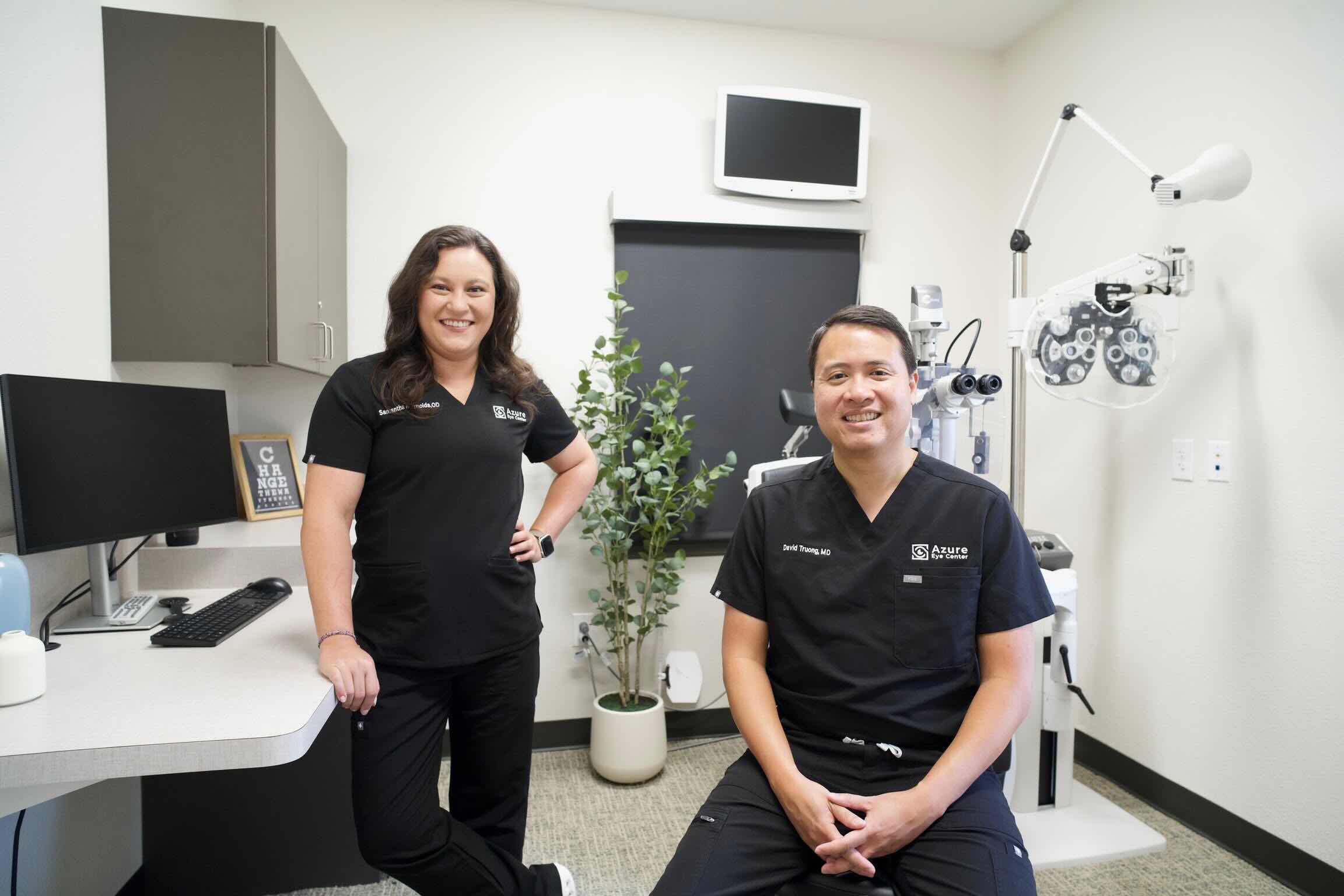
Dr. Truong performs every surgery at Azure Eye Center, and Dr. Reynolds provides much of the care before and after.
David T. Truong, MD, is a board-certified ophthalmologist who completed a fellowship in cornea and refractive surgery at the Jules Stein Eye Institute at UCLA. His training covers both laser and lens-based surgery, so he can recommend LASIK, PRK, EVO ICL or lens replacement based on your eyes. One patient review puts it plainly: "Does not try to sell unnecessary procedures." Meet Dr. Truong.
Samantha Reynolds, OD, a therapeutic optometrist and the 2025 Texas Young Optometrist of the Year, provides comprehensive exams and pre- and post-operative care for LASIK, PRK and other refractive procedures at both offices. Meet Dr. Reynolds.
Locations
Vision correction in Fort Worth (Alliance) and Colleyville
Both offices share one phone number, (817) 886-4600, and are open Monday to Thursday 8:00 am to 5:00 pm and Friday 8:00 am to 3:00 pm. Patients from Keller and Southlake can read about eye surgery for Keller and Southlake residents.
FAQ
Vision correction questions from Fort Worth patients
What is the best vision correction surgery?
There is no single best procedure. The best one is the procedure your eyes qualify for that gives you the most predictable result. LASIK and Contoura suit many people in their 20s and 30s, PRK suits thinner corneas or contact sports, EVO ICL suits higher nearsightedness, and lens replacement suits many people over 45. At Azure Eye Center, Dr. Truong performs all of them, so the recommendation follows your exam.
Is refractive surgery covered by insurance?
Usually not. Most medical and vision plans treat LASIK, PRK, EVO ICL and refractive lens exchange as elective, though some vision plans offer discounts. You can generally use HSA or FSA funds, and Azure Eye Center offers financing through CareCredit, ALPHAEON Credit and Cherry. Cataract surgery is different: when a cataract affects your vision, it is generally covered by medical insurance and Medicare, though premium lens upgrades are typically an added cost.
Why is ICL better than LASIK for some people?
EVO ICL corrects vision with a lens placed inside the eye instead of removing corneal tissue. That makes it a strong option for people with higher nearsightedness, thin corneas or other corneal findings that make LASIK less suitable, and the lens can be removed if needed. It is not better for everyone; LASIK works well for many moderate prescriptions. Dr. Truong evaluates both at your Fort Worth or Colleyville consultation.
What is the average cost of RLE?
Azure Eye Center does not publish a set price for refractive lens exchange because the cost depends on the implant you choose, whether one or both eyes are treated, and your measurements. RLE generally costs more than LASIK because it is lens surgery with an implant, and insurance usually does not cover it when it is done to reduce dependence on glasses. You receive an exact written quote at your consultation, and financing is available.
Is refractive surgery the same as LASIK?
No. LASIK is one type of refractive surgery. Refractive surgery is the broader term for any procedure that changes how the eye focuses light, including Contoura Vision LASIK, PRK, EVO ICL and refractive lens exchange. People often say LASIK when they mean vision correction in general, which is why the free LASIK consultation at Azure Eye Center also screens you for PRK, ICL and RLE.
Am I too old for LASIK?
There is no fixed upper age limit for LASIK. What changes after about 45 is that the eye's natural lens stiffens, so near vision fades even when distance vision is corrected, and early cataract changes may appear. For many people in that range, refractive lens exchange addresses both. Dr. Truong checks your lens health and focusing ability at your Fort Worth or Colleyville consultation to tell you which approach makes more sense.
Can astigmatism be corrected?
Yes, for most patients. LASIK and PRK reshape the cornea to treat astigmatism, and Contoura Vision is FDA-approved for nearsightedness with or without astigmatism. EVO ICL can correct nearsightedness with astigmatism, and toric implants correct astigmatism during refractive lens exchange or cataract surgery. How much astigmatism can be corrected, and with which procedure, depends on your measurements at Azure Eye Center.
Which vision correction procedure is safest?
Every procedure on this page is well established, and every surgery carries some risk. The safest choice is the one that matches your eyes. PRK avoids a corneal flap, EVO ICL removes no corneal tissue and can be removed, and lens procedures at Azure Eye Center are performed in a Joint Commission-accredited office-based surgery suite. Dr. Truong reviews the specific risks of each option with you before you decide.
Related pages
Find out which vision correction option fits you
Schedule a consultation at our Fort Worth (Alliance) or Colleyville office. Dr. Truong's team will measure your eyes, explain every option you qualify for and give you your price in writing.
This page is for general education and does not replace an eye exam. Candidacy, results and recovery vary by patient, and every surgery carries risks.